Medicina y Cirugía Oral y Maxilofacial: Medicina y Cirugía Oral y Maxilofacial

CIRUGÏA DE LA BASE DEL CRANEO
Ponentes
J.Poch Broto, J. Traserra, E. García Ibáñez, P. Claros, R. Avellaneda
Maxilectomía en bisagra o desarticulación temporal pediculada a mejilla del maxilar superior
J.J. Alvarez Vicent, L.Romero Castellano y C. Domingo Carrasco
Article Accuracy of a Computer-Aided Dynamic Navigation System in the Placement of Zygomatic Dental Implants: An In Vitro Study
Juan Ramón González Rueda 1 , Irene García Ávila 1 , Víctor Manuel de Paz Hermoso 2 , Elena Riad Deglow 1 , Álvaro Zubizarreta-Macho 1,3,* , Jesús Pato Mourelo 4 , Javier Montero Martín 3 and Sofía Hernández Montero 1
1 Department of Implant Surgery, Faculty of Health Sciences, Alfonso X El Sabio University, 28691 Madrid, Spain; jgonzrue@myuax.com (J.R.G.R.); igarcavi@gmail.com (I.G.Á.); elenariaddeglow@gmail.com (E.R.D.); shernmon@uax.es (S.H.M.) 2 Department of Maxillofacial Surgery, Quiron Health Hospital, 28002 Madrid, Spain; vdepaz@gmail.com 3 Department of Surgery, Faculty of Medicine, University of Salamanca, 37008 Salamanca, Spain; javimont@usal.es 4 Department of Surgery, Faculty of Dentistry, University of Navarra, 31009 Pamplona, Spain; jpatomourelo@hotmail.com * Correspondence: amacho@uax.es
Novel digital technique to analyze the accuracy and intraoperative complications of orthodontic self-tapping and self-drilling microscrews placement techniques: An in vitro study
Elena Riad Deglow, a Miriam O0 Connor Esteban, a Alvaro Zubizarreta-Macho, a ,b Sofía Hernández Montero, a Georgia Tzironi, b Francesc Abella Sans, c and Alberto Albaladejo Martínez b Madrid, Salamanca, and Barcelona, Spain
LOS TÉRMINOS: implantitis y Periimplantitis
Quizás se empleen a nivel Universal, traducidos al Idioma correspondeinte,
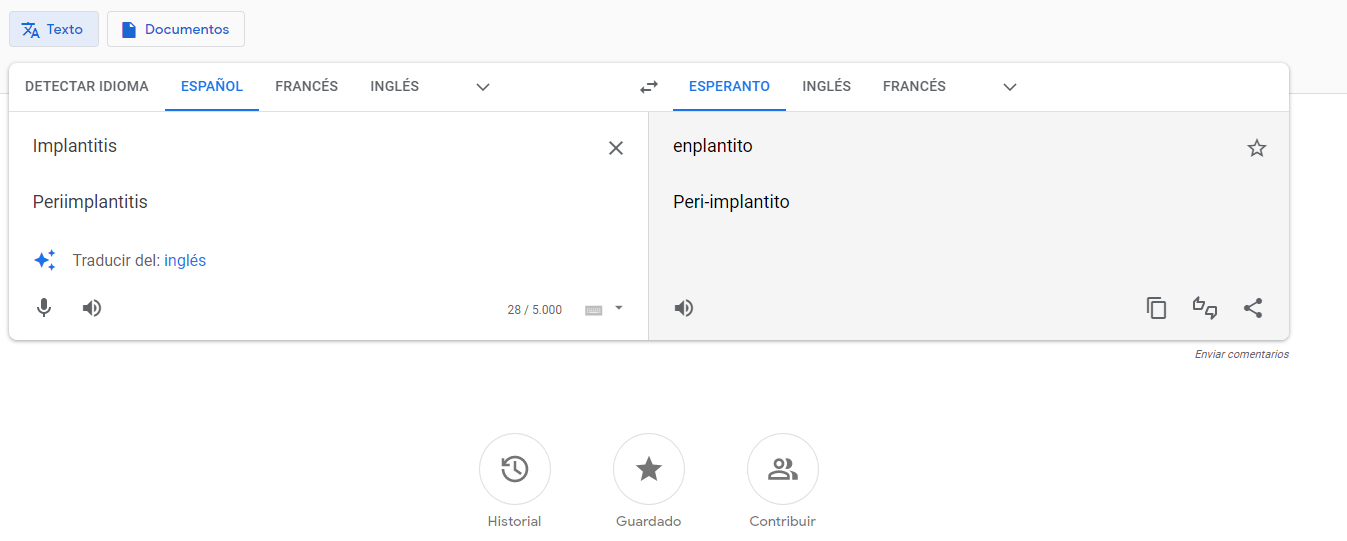
Proponemos para facilitar su conocimiento y ante posibles dudas, acudir al Traductor de Google, donde estan contemplados una gran mayoria de los Idiomas
Breve descripción del procedimiento de Traducción:
En la casilla que acoje los 2 Términos, a Traducir, elegimos, para nuestro caso, de Inicio del Español, para Esperanto, como ejemplo en:
Google Traductor
NOTA: Un servidor, no utiliza en su Prática Clínica, Científica ni en Publicaciones, los Términos arriba aludidos y en ningún idioma (puede leerse, sobre el particular, en:
Dr. Don Francisco Hernández Altemir
Colegiado Médico de Honor de Zaragoza 505004161
Colegiado de Estomatólogos y Odontólogos de Zaragoza-Huesca-Teruel 50000218
Académico Correspondiente de la Real Academia de Medicina de Zaragoza
Miembro de la Sociedad Española de Cirugía Oral Maxilofacial y de Cabeza y Cuello
Founding Member of the EASCMFS
Miembro Fundador de la Sociedad Española de Cirujanos de Cabeza y Cuello
Miembro Fundador de la Sociedad Española de Cirugía de la Base de Cráneo
Journal of Clinical Medicine
Article Influence of Static Navigation Technique on the Accuracy of Autotransplanted Teeth in Surgically Created Sockets
Elena Riad Deglow 1, Nayra Zurima Lazo Torres 1, David Gutiérrez Muñoz 1, María Bufalá Pérez 1, Agustín Galparsoro Catalán 1, Álvaro Zubizarreta‐Macho 1,2,*, Francesc Abella Sans 3 and Sofía Hernández Montero 1
1 Department of Implant Surgery, Faculty of Health Sciences, Alfonso X el Sabio University, 28691 Madrid, Spain; eriaddeg@uax.es (E.R.D.); nlazotor@myuax.com (N.Z.L.T.); dgutierr@uax.es (D.G.M.); mperebuf@uax.es (M.B.P.); agalpcat@uax.es (A.G.C.); shernmon@uax.es (S.H.M.)
2 Department of Orthodontics, Faculty of Medicine and Dentistry, University of Salamanca, 37008 Salamanca, Spain 3 Department of Endodontics, Universitat Internacional de Catalunya, 08195 Barcelona, Spain; franabella@uic.es
3 * Correspondence: amacho@uax.es
Abstract: The aim of this study was to analyse and compare the position of single‐rooted autotransplanted teeth using computer‐aided SNT drilling and conventional freehand (FT) drilling, by comparing the planned and performed position at the coronal, apical and angularlevel. Materials and methods: Forty single‐root upper teeth were selected and distributed into the following study groups: A. Autotransplanted tooth using the computer‐aided static navigation technique (SNT) (n = 20) and B. Autotransplanted tooth using the conventional free‐hand technique (FT) (n = 20). Afterwards, the teeth were embedded into two experimental models and 10 single‐root upper teeth were randomly autotransplanted in each experimental model. The experimental models were submitted to a preoperative cone‐beam computed tomography (CBCT) scan and a digital impression by a 3D intraoral scan, in addition to a postoperative CBCT scan, after the autotransplantation. Datasets from postoperative CBCT scans of the two study groups were uploaded to the 3D implant planning software, aligned with the autotransplantation planning, and the coronal, apical and angular deviations were measured. The results were analysed using Student’s t‐test and Mann–Whitney non‐parametric statistical analysis. Results: Coronal (p = 0.079) and angular (p = 0.208) statistical comparisons did not present statistically significant differences; however, statistically significant differences between the apical deviation of the SNT and FT study groups (p = 0.038) were also observed.
Conclusions: The computer‐aided static navigation technique does not provide higher accuracy in the positioning of single‐root autotransplanted teeth compared to the conventional free‐hand technique.
Keywords: accuracy; computed‐assisted template; computer‐aided static navigation; cone‐beam computed tomography scan; digital impression; tooth autotransplantation
Para ver el Artículo Completo Pinchar aquí
El Rector Magnífico de la Universidad de Zaragoza
a
D. Francisco Hernández Altemir
Global Organization for Excellence in Healt (GOEH):
Excellence in Healt Care Price
9 de Marzo 2005
A N E S T E S I A R
CURSO INTENSIVO DEL DIPLOMA EUROPEO DE ANESTESIOLOGIA
Y CUIDADOS INTENSIVOS 2022 10 Edición
Plazo de Inscripción12 de enero 28 de febrero 2022-
/ 26 enero 2022
Cambiando Paradigmas: Intubación submentoniana

PROF. DR. FRANCISCO HERNÁNDEZ ALTEMIR